Money Calendar vs Budget: Why One Feels Impossible and the Other Doesn’t

Writer
Mel Mandara

Editor
Erin Elizabeth Reed
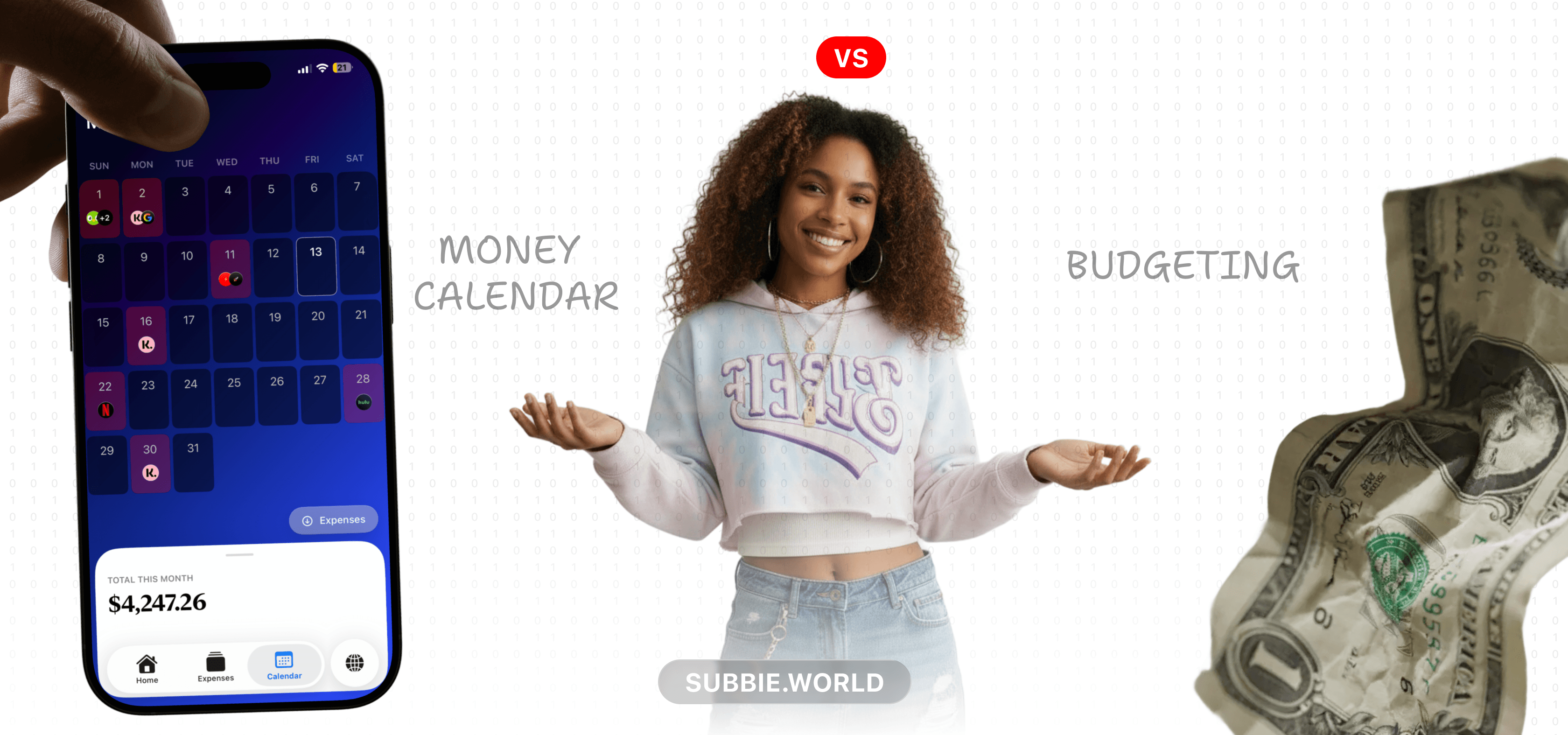
So you woke up one day and told yourself:
“today is the day, it’s the day I’m finally gonna get my financial shit together”.
You’re tired of feeling behind.
The last time you checked your savings account it said $57.19.
This is not where you thought you’d be at this age, huh?
So you tell yourself you’re gonna create a budget, and this time you’re actually gonna stick to it.
You put in the work.
You categorized all your expenses into neat little boxes and pinky promised yourself you wouldn’t spend more than $50 on eating out this month.
Things are going well the first week.
But like clockwork, around week three you say fuck it.
Who’s gonna tell you not to spend $7 on some tacos with my friends after work?
It's just a little fun, and it’s only $7… that’s not gonna change anything.
When you get back home, you beat yourself up. You feel ashamed for not being more disciplined.
"Why does budgeting just not work for me?" you ask yourself.
Well, let me be the first to tell you this: budgets don’t work.
And there’s science to back it.
By the end of this blog, you’ll understand why budgets feel impossible, how money calendars are different, and which one might actually work for your brain.
Let’s start with the basics.
What are budgets?
A budget is a spending plan based on categories and limits.
You decide ahead of time how much you're "allowed" to spend in each category: $400 for groceries, $150 for gas, $100 for entertainment, $50 for random shit you didn't plan for but definitely need. Because life.
Then, throughout the month, you're supposed to track every single purchase and make sure you stay within those limits.
If you go over? You've "failed." You're supposed to cut back somewhere else to make up for it.
The whole system is built on a few big assumptions:
You can predict your spending. Budgets assume you know exactly how much you'll need for groceries before inflation hits, before your kid needs new shoes, before your car makes that weird noise that means you're about to drop $600 at the mechanic.
You'll track everything consistently. Every coffee. Every tank of gas. Every impulse Amazon purchase at 11 PM. You're supposed to log it, categorize it, and reconcile it with your budget.
You have the discipline to restrict yourself. Hit your $100 fun limit on the 15th? You're just supposed to... not do anything fun for the rest of the month. No movies. No dinners out. You used up your "fun money." Sorry about it.
You'll remember to do all of this. Every day. Without losing steam. Without forgetting. Without getting overwhelmed and quietly closing the app, telling yourself you'll catch up tomorrow.
For some people, this works. They like the structure. They enjoy tracking. Their income is predictable, their expenses are stable, and they find the process satisfying.
But for a lot of us? It feels like trying to fit your entire chaotic life into a rigid box that punishes you every time reality doesn't cooperate.
What a Money Calendar Actually Is
Here's where things get different.
A money calendar doesn't care about categories.
It cares about time.
Instead of asking "how much should I spend on groceries this month?" (which requires you to predict the future, estimate costs accurately, and pretend your life follows a neat, stable schedule), a money calendar asks a much simpler question:
What's coming up this week(or month) that you need to know about?
That's it.
A money calendar shows your financial life on a timeline.
Bills. Paychecks. Subscriptions. Loan payments.
All of it laid out by when it happens, so you can see what's coming before it hits.
Not: "you're allowed $400 for groceries this month."
But: "your car insurance renews Thursday. Your paycheck hits Friday. Your credit card payment is due in 9 days."
No limits. No categories.
No punishment for going $7 over on tacos.
Just visibility.
The shift sounds small.
But the emotional experience is completely different.
I've done something I didn't even know was possible.
I rebuilt my relationship with money.
I used to feel quite anxious about personal finances but now?
I feel so secure because I know exactly what's coming and I can't be blindsided. Let's talk more about this.
The Emotional Experience (Because That's What Actually Matters)
Let me paint you two pictures. Same person. Same month. Different tool.
With a budget:
It's the 18th. You open your budgeting app for the first time in two weeks because honestly? Opening it has started to feel like getting called into your manager's office. You're already bracing yourself before the screen loads.
And yep. You're over on groceries. Over on eating out (the tacos). There's a red number in four different categories telling you that you've failed again this month.
You didn't even know you were over. You were just living your life.
You close the app. You feel like shit. You tell yourself you'll do better next month.
You won't open the app again until the 1st, when the shame cycle quietly resets and the whole thing starts over.
With a money calendar:
It's the 18th. You open your money calendar.
Your car insurance auto renewed yesterday. You knew it was coming (you saw it on the calendar last week) so it wasn't a surprise. Check.
Your credit card is due on the 20th. Two days from now. You can see your current balance and you have enough to cover it. Check.
Rent is on the 1st. The calendar shows exactly what you'll have left after all your upcoming charges clear: $340 for groceries and gas between now and then. Not guessing. Knowing.
You close the app feeling... fine, actually.
That's the whole difference.
It's not about the numbers.
It's about how those numbers make you feel when you look at them.
Budgets build a relationship with money around restriction and judgment.
You're always either succeeding or failing.
And when you fail (which everyone does, eventually) it triggers shame, which triggers avoidance, which makes everything worse.
You stop looking.
You fall further behind.
You feel worse about yourself.
Money calendars build a relationship with money around information.
You're not passing or failing anything.
You're just seeing what's true.
And when you can see what's true, you can actually do something about it before it turns into a crisis.
One tool makes you want to hide. The other gives you a reason to look.
Who Budgets Work For
I want to be fair here, because budgets genuinely do work for some people.
If your income is the same every month, your expenses are mostly predictable, and you find some kind of satisfaction in tracking and categorizing — a budget can be a solid tool.
It gives you a clear framework.
It creates intentionality around spending.
And if the structure feels like a guardrail rather than a cage, it can be genuinely useful.
There is nothing wrong with budgeting if it works for you.
But if you've tried multiple budgeting systems, given them a real shot, and keep ending up in the same shame spiral?
It's probably not a discipline problem. It's a tool problem.
Who Money Calendars Work For
Money calendars work especially well if you:
Struggle with time blindness. If "next week" and "next month" feel the same amount of far away, a visual timeline turns vague future bills into concrete, visible dates. Your brain doesn't have to hold the whole schedule anymore. It's right there in front of you.
Have ADHD or inconsistent habits. Budgets require you to show up every day, log everything, and stay consistently engaged. A money calendar doesn't. If you forget to check it for a week, nothing breaks. The information is still there when you come back. You're not starting over, you're just catching up.
Have variable or irregular income. Freelance work, side hustles, multiple income streams... budgets were built for steady, predictable paychecks. A money calendar tracks what comes in and when, without making you predict it in advance.
Are carrying debt and can't see the end. When you're in debt, a budget just shows you what you owe. A money calendar shows you a timeline: actual payment dates, actual payoff dates. You can see the finish line. That changes things more than you'd think.
Have tried budgeting and keep quitting. If that's you, it doesn't mean you're bad with money. It means the tool wasn't built for your brain. This one might be.
Where Subbie Fits In
As an example of a money calendar in practice: Subbie was built specifically to work this way.
Not another budgeting app with a slightly friendlier interface.
An actual money calendar.
Your bills, income, subscriptions, and debt payments all on one visual timeline.
You can see what's due this week, what auto-renews next month, and when your debt will actually be paid off.
With a real end date. Not "someday." A date.
No categories or abstract spending limits.
Most importantly, no guilt when life costs what life costs.
Subbie provides visibility by helping you to see what's coming before it hits.
If you want to go deeper, start here: What Is a Money Calendar?
You've been trying to make the wrong tool work for a long time.
Maybe it's time to try the right one.